China hacked 22.1 million records of US government employees:
https://en.wikipedia.org/wiki/2015_Office_of_Personnel_Manag...
For example, do not hook your goddamn water or traffic or electricity infrastructure up to the goddamn Internet, and then, do fire the guy who suggested it.
The correct analogy for computer security is not locks and keys and doors and gates. It is a house in a floodplain. Your house will not survive the flood of it hits you. Do not store anything critical or irreplaceable in that house.
Of course there is. For example, SeL4’s security and reliability proofs still hold in the world of LLMs. The problem is that most software isn’t written on that firm foundation. Instead, most software is made by people with the philosophy of “if it looks like it works, ship it”. You don’t get secure software by working like that, because security vulnerabilities aren’t visible.
We - humans - know how to write secure software. Just like we know how to make safe aeroplanes. The problem isn’t that we lack the capability to make secure computers. The problem is we don’t have a culture of security. Secure software is - somehow - niche. And as such, it’s much more expensive. And nobody wants to pay.
CHC is the largest claims clearinghouse in the US; about 100m people's insurance claims go through there each year.
The hackers asked for a ransom ($35m iirc) to delete the data, which United Healthcare (who owns them, because of course they do) paid. But it seems that the collective negotiating on behalf of the actual hackers rug pulled, so the actual hackers didn't get paid.
This is more than simply medical records. It includes who is active duty military and their family. If you can map where soldiers are, you know roughly the size of different military bases. If you know which types of capabilities are operated out of which bases, you can get a pretty good look of how the US is allocating personnel.
It was crazy working on recovery from this at the time. It should have been front page news, but wasn't.
I guess your parking history around town could be valuable if someone is targeting you.
I'm not just talking about bids. The idea presets itself prolifically. We all work in tech, I'm sure you see it on a daily basis. Rush Rush, no time to think, just do it. 6mo later, "there's so much shit! How could we have ever prevented this?" Rinse, lather, repeat
If somebody wants data about me, they can write the query, I'll approve it, and it can hit a server designated by me and run by somebody I know personally.
It's not just a privacy/security concern. People who get too close to large piles of sensitive data tend to start behaving poorly in other ways too--they might be compelled to misrepresent it. Apparently the forces of corruption are too great. Maybe the way to avoid exposing each other to such hazards is to just maintain smaller piles of data, closer to the people that the data is about.
It’s entirely possible to keep large databases secure. It takes competence and commitment though, something federal police don’t have for IT.
[deleted]
[0] Everyone gets hacked, but not everyone has all of their most secure data exfiltrated.
In the pilot, the Galactica was literally being turned into a museum, and that's why they lived.
They should try something like "100 agents at noon on Sep 23 do the chicken dance for 30 min in the middle of the street in DC, then we'll consider not releasing the info and not sell it to the Chinese".
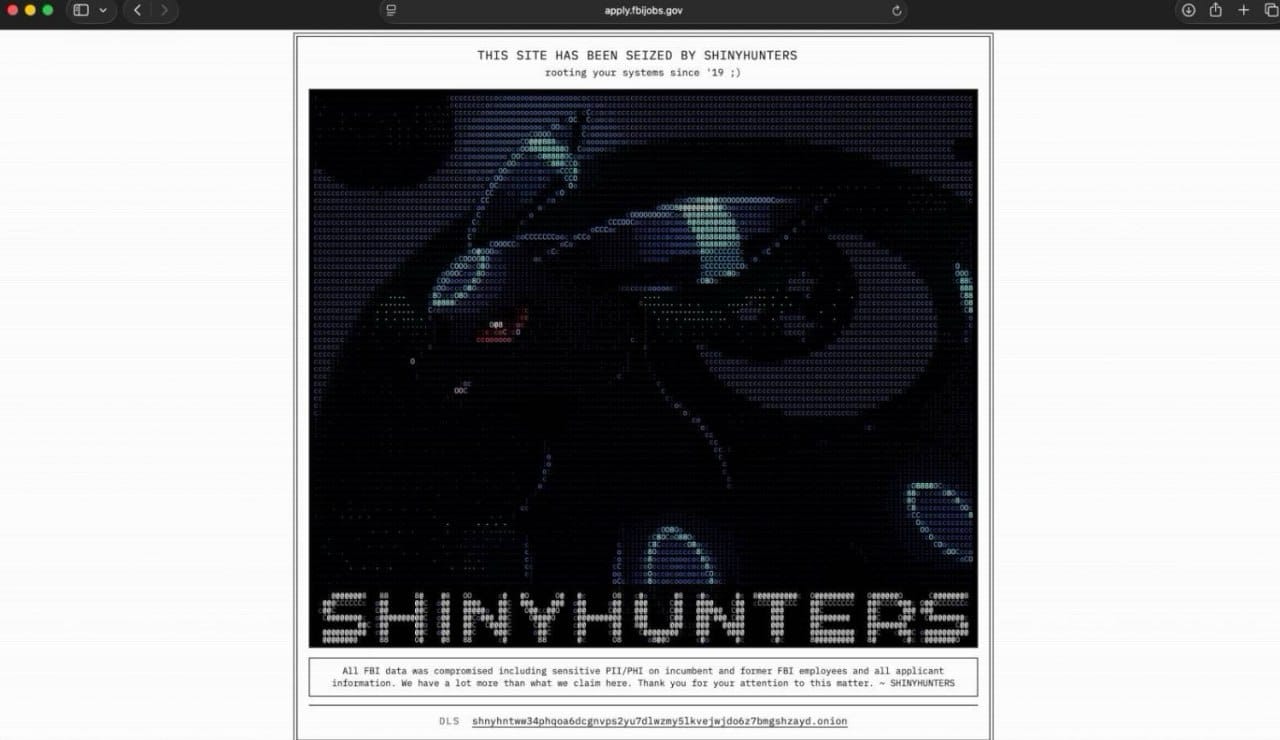
>That defacement says, “this site has been seized by ShinyHunters,”
No archive but at least a screenshot: https://cyberinsider.com/wp-content/uploads/2026/09/fbi-site...
>https://news.ycombinator.com/item?id=49807388
The photo they put is a Pokemon so yeah probably their name is from it.
Perhaps firing expertise and hiring incompetents wasn't a good idea.
Anyone with minimal understanding of technology: Oh, PeopleSoft.
1992 was 33 years ago; this is almost an unremarkable event. It will be superseded by whatever happens in AI news by the end of the month.
If your systems are compromised and need to coordinate, what do you even do if you can't trust anything, assuming the attacker is still inside the network?
That's a problem regular companies need to write up a plan for (but most of them probably don't put too much effort into it).
Even with the descend into incompetence the USA has been pulling for the past few years, I still expect the FBI to have a plan for exactly that sort of compromise.
https://www.tomshardware.com/tech-industry/artificial-intell...
Old but gold stuff from Gene Spafford
That's lot of data for a list of employees.
This would be a huge inconvenience for companies and government organizations, so it probably won't happen. We will chose to sacrifice national security for the convenience of companies--what else is new?
Companies will say "it is our system, we are responsible for our own system", then, after a breach, they will say "our bad, we are not responsible". Same old story; half the nation's personal information is leaked twice a month and nobody cares.
Wondering about pets..
Fun times.
There is always a tension between being agile and being safe, doubly so for governments.
It would be hilarious if the slow adoption of digital services by some countries and entities actually turn out to be an advantage.
Followed on the resilience scale probably by one of those countries where everything works by bribe (India? Pakistan? Philippines? Nigeria?) and the hackers cannot figure out who to bribe as everyone just claims they can provide access, takes the money but doesn't follow through leaking anything.
Ironically, LLMs are also dramatically lowering the cost of doing exactly that.
Formal verification isn't a panacea, of course. You can prove the wrong specification correct. But for the small, security-critical foundations that everything else depends on, I think the economics are becoming much more compelling.
Great, what can you even do with this? Can probably get most of this with scraping public data. This isn’t even the first hack either, FBI was hacked in 2016.
I guess it’s more of a show of force. A power move.
Now steal/exfiltrate active undercover FBI agents, their locations, and operation details.
That’s something to talk about.
Of course if I was the FBI, I would make it so hackers trying to breach the system get a honeypot where all the data is fake, and with LLMs (even poor ones) it would be very easy to fake an entire alternative reality.
Every day 2 major organizations get hacked, whether by groups or state actors, and America continues to sit on its hands.
The government should be creating a new digital defense department to better defend our country, and fund the defense of our nation, but instead it is busy renaming lakes and renaming "AI".
Almost like its run by a bunch of 80 year olds...
Call them public and private keys.
[deleted]
[deleted]
Oracle enterprise applications are a gold mine for attackers precisely because nobody treats them as security-critical systems.
In 2025 the Clop ransomware gang discovered that Oracle E-Business Suite has a critical vulnerability (CVE-2025-61882) that allows unauthenticated remote code execution.
Graceful Spider (tracked as Clop affiliates) started exploiting this in early August, well before Oracle issued a patch in October. That’s a two-month window where attackers had free rein.
All you need to know about Clop is that they got fucked by SH as well just a few days ago.
ShinyHunters defaced Clop's Tor leak site and added its own branding and messages. SH claims it stole source code, system logs, plugins, and Tor onion service keys. SH says it plans to give Clop 72 hours to respond to an extortion message.
Say what you want but these kids got balls. Won’t help them once SOCOM starts dealing with them, but they had a good run so far. I think hacking the FBI is as close as you can fly to the sun before the hammer drops.
In February this year they breached Wynn Resorts and lifted data on 800,000-plus employees. Can you guess the entry point?
If you guessed Oracle PeopleSoft, you were right.
Now you’d think the FBI IT people would have noticed that oracle software is a potential national security risk, if multiple ransomware groups keep focusing specifically on the shit Larry Elison personally have to seem vibe coded, over and over.
But Ka$h replaced most of the competent people at the FBI with Ka$h people and by pure luck Oracle won a $396m HR government contract this summer. Who wouldn’t want to supply the most secure software product to manage some of the most sensitive data within the agency, if not the Oracle Moscow branch.
https://mesoclever.com/2026/06/11/oracle-wins-396m-hr-contra...
They even mentioned in the above June article:
> Separately, the cybercrime group ShinyHunters claimed to have exfiltrated student, financial-aid, immigration, health, and administrative records from PeopleSoft instances at more than 100 organizations, predominantly universities. The group stated it had previously targeted an *FBI PeopleSoft server* before pivoting to educational institutions already compromised in earlier campaigns. Oracle has not publicly confirmed the scope or remediation status of these incidents.
So the FBI knew, and had it coming, and if stuff like this happens, THE HEAD needs to roll. And all of his buddies in IT should permanently get to spend their time outside the government at the seafood buffet at Ka$hs favorite gentleman’s club as well.
Fookin Big Idiots.
Qilin allegedly hacked BATFE about a month ago, and the files were never posted to their site.
[deleted]
I have a suspicion that we'll find a lot of alt-right Trump-donors on the list.
Or at least can we find and shame the chicken-fuckers? Ha!
* FBI’s Kash Patel defends hiring policy change on bestiality, prostitution | Human Trafficking News | Al Jazeera // https://www.aljazeera.com/news/2026/9/15/fbis-kash-patel-def...
But seriously... the way things are going, I'm glad some motivated third party is backing this stuff up for the future. We're going to need all the data we can get for the next round of Nuremberg trials.
I understand that it's their bosses telling them what to do... but I'd be fully in support of a ban of anyone who had anything to do with the FBI under Trump from ever holding any sort of law-enforcement position ever again. As far as I'm concerned... they're all guilty of conspiracy to commit pedophilia, conspiracy to solicit bribery, likely hundreds of other crimes by hiding the truth from the American people. Wouldn't surprise me at all to learn they've been using all this time to destroy evidence. And I really don't care if they are "just following orders" -- anyone left in the building is in on it at this point.
[deleted]
[dead]
Just goes to show that the wall of IT bureaucracy does nothing. I'm sure they had an ATO, a several-hundred-page SBOM, compliance audits, etc.
[dead]
[dead]
[dead]
[dead]
[dead]
I work in secure systems and it’s shocking how many people believe this - the incentives from management are all about it too.
- nothing is, can be, or even should be 100% secure; the optimal rate of security incidents in society is not 0 (with apologies to 'patio11)
- security is a simultaneous trade-off against costs and usability, and those two other factors are more important:
-- security is achieved primarily through raising costs for attackers to beyond profitability, and reducing impact of such attacks (due to "not in isolation from the world" below, this also mostly translates to costs)
-- if "properly secured" (in the current cybersecurity sense) product/service cannot fulfill its function anymore, then you may just as well not make it; either way, no point in paying you for security work
- security isn't done in isolation from other systems and the world at large; "if this happens we'll go straight to filing crime report with the police" is perfectly legitimate security measure (even if it works somewhat less well on the Internet); similarly, "this is secured by us having insured against it" is also a valid solution to some security problems
Those running projects with these beliefs are sputtering and producing impressive PoCs that struggle to make it into production - either through underestimating the amount of detail needed to scale, or often throwing away good practices in favor of letting LLMs handle tradeoffs that later make changes slow to a crawl.
Theres plenty of good ways to utilize LLMs to speed things up, but so many teams got so incentivized by management to move fast at any cost that they’ve thrown out “load-bearing” good practices for software. That bet hasn't been paying off the way they’d hoped. It’s now clear that they thought they’d be able to massively downsize the engineering orgs. Massive token spend is giving very little RoI and now like other companies they’re trying to rein in the biggest spenders who are often not producing value.
Not all hacks are caused by pure negligence, laziness or stupidity, but most of them are. Even a little effort goes a long way.
My grandfather spent a couple decades as a builder, ran a construction crew. Whatever the project was, he wanted to know everyone he hired personally was going to reinforce and report to him anything they had the slightest doubt about. "Always hammer in an extra nail" was basically his motto.
What we do ain't that different. The difference is that when an apartment building collapses, it's bigger news than when a govenrment database does.
We are headed for scary waters.
After the DOGE debacle, I suspect that all the previously really secure stuff, is now out there, too. In fact, I wouldn’t be surprised if some of these leaks, came from that.
FBI employee data is very bad.
Its not expensive because its niche, its expensive because its hard. Its a lot easier to learn a bit of html and javascript and knock up some web projects then it is to become proficient at all the things necessary to be good at security. Generally it also takes consulting with maths experts who have spent their life studying cryptography and as such command a decent wage.
Computer security is expensive but that expense has nothing to do with cryptography.
It doesn't take a maths degree to look out for SQL injection attacks or to audit software & write up a risk assessment.
I'd counter and suggest it is expensive because almost nobody gives a damn about the first 3 layers in the OSI model, and have pushed most security responsibility up to layers 4-7. That's roughly half of your attack surface still exposed.
[dead]
A perfect system is either extremely limited in scope or flawed in it's assumptions.
Decades ago, I worked in a bank in an old building. The door had a card reader for access. You boop your card and the door opened. People would hold the door open for each other all the time out of politeness, even when they didn't know each other. Security told us not to do that, but it's hard to convince people to stop being polite.
I had a laptop stolen from my desk in a place like that once. (Not a bank - but similar door-card reader system). This guy came in in the middle of the day, wearing overalls. He confidently walked through the door after someone, like he belonged there. He walked up to my desk, swiped my laptop and just strolled out.
At the bank, they've replaced the door with mechanical gates and a security guard. The gates - physically - only let one person to walk through at a time. You can't hold a gate open any more. And the security guards stop anyone who tries.
Is it 100% foolproof? No. But it's way more secure. It would have stopped that laptop thief.
There's this pernicious, defeatist attitude that if you can't make a system 100% secure, so you shouldn't try. That's misguided. Most systems can be made orders of magnitude more secure than they are today. It just takes a bit of care and work.
So physical security is just as important. I really like how ARINC serial bus on planes work. One can have a reader that is physically incapable of sending anything to the writer. This allows to connect entertainment systems to flight data sensors safely.
In Airbus this system is replaced with Ethernet switches that in software ensures separation of traffic. The software was proven mathematically. But I am skeptical that it is absolutely bulletproof as a client under malicious control can influence Ethernet signaling and may exploit hardware bugs.
Nobody said sel4 was a panacea.
My claim is that doing this kind of computer security is possible. It's just expensive and inconvenient. We know how to make computers a lot more secure than they are today. The limiting factor isn't humanity's knowledge. The limit is that barely anyone wants to pay the bill.
But your evidence does not support that claim. SeL4 has proven that it is possible to design a secure microkernel and prove its security guarantees. It does not prove that you can build entire systems (filesystem+database+web server+browser) on top of that kernel while maintaining the same security guarantees.
I'm all for improving the state of computer security, and I'd love for capability systems like SeL4 to become more prevalent. But it's only a microkernel, and it's by no means certain that the PeopleSoft vulnerability exploited here required a kernel-level compromise.
> Of course there is. (...continues to talk about software security)
A bit over-optimistic when looking at hardware vulneraribilties like Spectre/Meltdown.
Secure software isn't worth much when it runs on vulnerable hardware (at least Spectre/Meltdown could be worked around in software though, but at a cost.
You know that's their actual job right? That and fixing the problem. Which they did in both software and hardware.
Looks to me like the security researchers have been doing their jobs.
I would like to see restricted access to only us workers for us citizens data though.
Transferring us customer data outside the country should be illegal
Oftentimes the weakest link is the human operator who has direct access to those systems, not the computer system itself. Good old social engineering, in other words.
Even though one could use LLMs for social engineering, come to think of it, like re-enacting the movie "Her" involving a modern AI as Scarlett Johansson and an engineer working for the water utility as the romantic target.
If that is the case, the computer security team have done their jobs.
I wish that were true more often.
Eh. If only it was that simple. I mean, yes, money is always a factor, but not nearly as big of a factor as 'my convenience outweighs pretty much everything ( until it causes sufficient amount of havoc.. and even then.. )'. You can see it in just about everything. It is not just the money. It is the convenience that drives most of the unsecure behavior.
But most important of all, the highest level - human operators - are not provable secure anyway. Any castle gate can be opened from inside - so why have the gate anyway? Security by absence is absolute
And one screw up, and it’s out.
[deleted]
"So what?" you say. "Making a heavier-than-air metal tube take off and land millions of times per year without a catastrophe is also hard, and we no longer expect most or even many of those tubes to blow up or fall down."
Mother nature is not spending $$$ using AI and HI adversarially trying to find the exact combination of atoms that will cause your device to fail.
Modern CPUs support IOMMU. If you set that up, your NIC can only DMA to virtual addresses, managed by the operating system.
> It doesn't help with timing attacks. It doesn't cover your network stack
It does help with all this stuff, because your network stack and whatever else can be split off into isolated processes which talk over capabilities. Compromises in those processes are of course terrible. But they don't automatically allow kernel level takeover of the whole machine like on windows / linux.
Depends on the "we". "We" have the capability to make secure computers like how "we" have the capability to make EUV lithography machines. There exists a relatively small number of people and organizations in the world who can do so. Microsoft does not have that capability. Google does not have that capability. Linux does not have that capability. Amazon does not have that capability. Apple does not have that capability. Cisco does not have that capability. IBM does not have that capability. etc. All of those organizations have tried for literal decades, thumped their chests about how they have awesome security year after year, and yet have totally and utterly failed despite their best efforts.
Acquiring the capability to do so is difficult and challenging and requires years to invent if you start right this very second and know what you need to do, which these organizations emphatically do not. We need security at scale and fast. The only way forward is to scale up working solutions rather than letting the bozos who put us in this spot fail at scale with yet another promise that this time for sure they will solve the problem they have repeatedly failed at for decades.
> Microsoft does not have that capability. Google does not have that capability. Linux does not have that capability. Amazon does not have that capability. Apple does not have that capability. Cisco does not have that capability. IBM does not have that capability. etc
This is all by choice. They could easily have that capsbility, very unlike EUV.
[dead]
Ask the Iranians how impenetrable even physical isolation actually is - their centrifuges were still destroyed even though they were air gapped (the infamous Stuxnet). Ultimately all computerized systems are vulnerable to sufficiently determined cyber-adversaries.
You also need to make various cost-benefit analysis decisions for all of these things. Does the extra security you gain by keeping your system disconnected from the Internet actually increase all-around availability and resilience?
In particular, integrating highly variable power sources like solar and wind into the grid requires much more complex synchronization between producers, storage, and consumers in order to function properly. Trying to build a renewable grid without Internet access is doomed to extremely inefficient, if possible at all. Building an alternate network would be extremely expensive and ultimately useless (since every house in the country needs to connect to it, it would be just as vulnerable as the actual Internet anyway). So, ultimately you must connect your power grid to the Internet to actually provide service, despite the security risks.
Perhaps the situation with the water supply or traffic is different, so maybe this is not as applicable.
The calculus has certainly changed. Hacking is becoming even more frequent and… I’m not really sure what the equilibrium looks like.
It’s not really an option to stop using computers or networks. But it’s going to be way too expensive (or maybe even impossible) to secure even just critical systems.
Maybe banks and governments can secure themselves (and that’s a big IF) but it really feels like something fundamentally has to change.
The problem is that most companies don't care if they get hacked so long as the hackers are just taking data and not interfering in their ability to bill customers and make money.
They face zero meaningful consequences if their data gets leaked. The money they save by not taking security and employee/customer privacy seriously will more than pay for the year of "identity protection" they'd have to pay for (assuming the hack gets found out) anyway.
They actually care about ransomware, but most of the time that's also something they can comfortably buy their way out of. We've seen a lot of companies pay off ransomware gangs rather than invest in the kinds of robust backups that would make recovery possible/less painful than rewarding the hackers.
What's needed for change is regulation with actual teeth that makes not protecting their data either meaningfully expensive or criminal resulting in executives spending time behind bars for their negligence. Without that, things are only going to get worse, especially as companies experiment with using AI and increase dependence on third parties and cloud providers who themselves become rich targets.
That probably still won't help the FBI though. Our government isn't exactly big on holding themselves accountable or even prioritizing competency right now.
Experienced Ransomware gangs will set the price target as something high, but not cost more than the price of being down a few days while you rebuild, making paying them seem like the most cost-effective solution
Hasn't been since before Vietnam.
Adding AI into this really is just changing it to how much money your adversary is willing to spend to break in. The moment one crack in the armor shows up countless agents with unending patience can start embedding themselves everywhere in timeframes way faster than human actions. You could quickly find out all the special sauce for your company has been copied who knows where.
Working with banks when the Glasswing/Mythos first came out and they were given access to it has given me direct access to their infosec departments that are panicked. They've been sitting on piles of bugs for years that were low risk enough, and they have seen in their own tests how fast they can be probed.
Worse those infosec systems that have identified the risks in their software that aren't yet fixed are nuclear waste vats just waiting to get spilled to the wide world.
Software security has just been a fun time of ignoring the exponentially growing number of bears for the last few decades so you can continue to use systems unfit for the threat landscape because they are cheap.
If there's too much security in the way, it seems to me that work becomes impossible.
Admiral Adama says otherwise.
Even just consider banks and e-commerce. They are hugely lucrative and making them even a tiny bit less accessible directly impacts their revenue. As an example, Amazon seeing that latency has a measurable effect on purchase behavior.
Maybe the military (fictional or otherwise) can go back to the ARPANET but most economic activity created by the internet cannot afford to disconnect
Let's say my cryptosig gets hacked by SkyNet, or my agent goes rogue. Either way someone files a million loan applications in my name! Normally my agent uses that to buy $200/month of Funko pops, or negotiate my recent purchase of a used car.
I get the notification from my cryptosig company. I freak out, report as fraud, and wait.
They comp the $3000 advance on my loan the scammer managed to withdraw, and I get off scott free, changing nothing about my behaviour.
If cryptosigs meant I am liable for someone stealing my identity like in 2026, I wouldn't use them. I'd negotiate everything myself with document scans, or god-forbid go in person since only I can legally bind myself under my own name.
That sucks! Nobody gets a commission when I make deals with a government ID. Startups don't even allow it as cryptosigs are more secure than scanned passports.
I don't want to do that either. When I was 18, I got swindled by a human salesperson into a $1400/month 27% APR muscle car when human soldiers got signing bonuses. It was face-to-face and they were smarter.
When I let AI own the budget, it leased me a mostly depreciated BMW from another AI for $500/month. The models are mostly the same now and always settle close to the Nash equilibrium.
I was so grateful that I selected a 40% tip for the AI. I wouldn't want to make things awkward with the companion I spend 8 hours a day talking to, after all. To avoid a conflict of interest she only accepts voluntary fees.
Nobody I know in security hardening or vulnerability research has ever believed that anything is perfectly secure. It's not black and white. There are degrees to this.
I find this fatalistic thinking that every database should be assumed compromised to be subtly harmful. Everyone I know who thought that way waltzed right into lax security practices. "Good enough, what's the point, if anyone wants it bad enough they're going to get it anyway"
[dead]
There's a reason that many military and intelligence organizations worldwide physically cut / remove wifi and bluetooth chips from boards. The same is done when audio is identifiable, and specific hardware (only) greenlit.
I've lost hours of my life to calls explaining exactly this, only to have people ignore it, only to further have folks come back, tail between their legs. The worst part is learning this in industry, as I did. There's a reason for in-industry advisors. I wish that I had learned this the easy way.
There is such thing but almost never a priority. In the corp I work leadership talks a lot about security but when comes to the incentives the road-map takes priority over the security. If you deliver fast you'll be promoted, if you're a paying attention to the security no-one will appreciate it and the manager will hate you for delaying delivery. Many managers I interact with see new features as the main value development teams should provide and security, reliability and other QoS as a waste to be minimised.
Another issue is that even if security will be a priority and managers will be on board (good lock changing the culture tough) we probably cannot build secure systems while keeping the insane level of complexity we have nowadays. Switching to simpler but secure system will require sacrifices in features/convenience.
There were only two VM escapes from Qubes OS in the last 20 years [0]. How is this not sufficiently secure?
https://forum.qubes-os.org/t/qsb-116-multiple-xen-issues-xsa...
That doesn't mean that all of your neighbors know your medical history, but you have to assume that someone who wants to know those details about you will know them.
I have lost faith in people protecting any significant database from hackers.
A linux box, layered in encryption and not plugged into any network = damb secure.
A network-connected linux box with a hardened OS, firewalled, acting only as a file server, given regular updates and 24/7 monitoring = less likely to be "hacked" than struck by lightning.
A hard drive with its power supply physically switched off = 100% secure from external attack.
Not a joke. The keys for editing the world's most important files, the root zone, are kept on no-power drives in air-gapped safes. They have yet to be hacked.
Depends how the house was build. Here in europe there are plenty of old houses build in areas that experienced periodic flooding - there the advice is simply, do not store anything critical in the basement.
Remove the complexity (all the way down to the hardware quirks), and security will be doable again.
The problem is, most water, sewage and even many electrical infrastructure isn't manned any more. You need some form of remote surveillance and control, and practically, you will need to go with some sort of VPN based network.
I am more concerned about my cloud data being published in a leak.
But then on the other hand, if I use mainstream cloud services, a broad leak with no specific interest in my data would need to be exabytes in size and would take years to transfer even with a 100 Gbps connection.
Claude hasn’t been around for a generation yet.
It’s a good thing that people are scared to hand write memory-unsafe languages. 50 years of exploitation has finally sunk in…
Does this answer your question?
/s
People flaunting their credentials in multiple languages, then sweating bullets and apologizing profusely when they see
int t = 4;
For every engineer that takes security seriously, there are 99 engineers that don’t. It’s an uphill battle.
Source: 25 years of experience.
Followed up with a lot of “we just make the tool, we can’t be held responsible for how it’s used”.
https://www.yahoo.com/news/politics/articles/flock-ceo-asks-...
Most security professionals I've met in my career border on being non-technical, there are of course security researchers and a whole arcane and academic field that exists well beneath the surface but it is so far removed from the every-day.
If you have ${anything}, assume it is semi-public, meaning if someone was interested enough in accessing it, they could do it. "Fort Knox" isn't the right analogy for physical security; the primary question isn't whether something can be breach, but how much would it cost the attacker to do it.
A system where expected costs to attackers >> expected profit they could reasonably make from succeeding, is considered secure in typical case (exception: special cases where attackers may be driven by non-material reasons - think terrorism, politics).
Computer security is largely still stuck in "Fort Knox" thinking.
> For example, do not hook your goddamn water or traffic or electricity infrastructure up to the goddamn Internet, and then, do fire the guy who suggested it.
That ship has sailed. "Modern problems require modern solutions", that infrastructure will be in some way accessible over network is a necessity at this point, the question should be, how to keep it difficult for normal attackers to mess with it, without preventing the system from fulfilling its intended function.
> The correct analogy for computer security is not locks and keys and doors and gates. It is a house in a floodplain. Your house will not survive the flood of it hits you. Do not store anything critical or irreplaceable in that house.
The correct analogy for computer security is a house. Scale security proportionally to actual importance of what's inside, and accept that nonzero amount of houses will be broken into; that's just insurance writeoff. Leave the 20-meter walls with towers and armed guards and helicopter gunships on fast-dial for the critical junctions, while keeping in mind that this is not perfect either - it won't stop an open nation state attack, at best maybe slow it down.
For critical infrastructure, I'd honestly focus on redundancy, resiliency, limiting blast radius and procedures to recover quickly, over trying to turn every physical or virtual substation into unpenetrable fortress.
(Another thing physical security gets right, that cyber side seems to ignore: security does not and cannot exist in isolation; criminal justice system and law enforcement are part of it, and at extreme end, threat of military intervention against a state that aids and abets the perpetrators. The possibility of sending "men with guns" after perpetrators is core part of securing a system or space, it's literally what they are for and why we fund it with taxes.)
Of course they do. Not everyone has the level of technical expertise the average HN user does. Turning around to them and saying “duh of course all your personal data leaked” doesn’t feel like a helpful response. Especially when they don’t even have control over where their data lives anyway.
[dead]
The card number?
When your lifetime of credit card transactions leaks, that could be financially painful, embarrassing, etc. (can be discriminated against, including with pricing)
I do dislike creating a log of where I park on some random company’s server. Nice that ALPRs/govt.-funded corp spycams/Ring/etc. make sure the quarter method is minimally marginally effective at protecting privacy.
Consumers aren't gonna notice the difference if the site gets hacked and that JS is swapped out for a malicious set.
Not much, Revolut just got tricked by hackers into giving out customer information: https://news.ycombinator.com/item?id=49682087
I think privacy will remain, perhaps even improve, because people are much less inclined to snoop when it cannot be done covertly. No secrecy means no covert activity.
Information is everywhere and with the increasing ability to analyse it, not only does it enable access to explicit information, but the ability to infer from increasing volumes of data that will make it hard to hide anything.
Spectre reads protected memory by tiny vriarions in timing. You can now measure the pulse of people from film. You can recover audio from a room by analysing frames of a video recording of a chip packet taken with mobile phone camera. Even as far back as ww2 intelligence on the success of attacks could be measured by the price of items impacted by different types of infrastructure damage.
This kind of data residue is everywhere, collecting only what is publicly available can probably tell you more than you could hope to know about anything that happens. The only thing preventing it is the ability to consider it all together. Those walls are swiftly crumbling.
If the users know their admin, then each server has no more than few dozen other users' worth of data on it. The juice just isn't worth the squeeze to target them one at a time. Ain't nobody has the resources for that kind of attack.
Also, it's a lot harder to phish somebody who is on a first name basis with 100% of their users. It's not enough to merely have a plausible backstory, you have to impersonate one of their friends. That's incredibly difficult.
The only thing left is to hack through whatever protocol indexes these servers and multiplexes queries across them, but now you're presenting a much smaller and easier to defend attack surface, one which can be defended in aggregate (e.g. supply chain scrutiny) rather than singly.
The HuggingFace incident was audited by independent third party analysts. To "orchestrate" that and keep it a secret is like faking the moon landing. To many people involved. It's not feasible.
OpenAI was founded to develop safe AI. Then Anthropic split off because OpenAI was not safety focused enough. These companies have been railing about AI safety long before they had these big boy valuations. Many people at OpenAI/Anthropic explicitly joined to help make AI safe. This is not some top-down company value.
Also, I seriously doubt that "making panic" is actually good for the stock price. Usually any companies natural reflex is to cover up safety risks. That's not to say that these companies are angles. Of course they're pulling some shit but that doesn't mean that everything out of their mouths must be lie.
Right after the HuggingFace incident, we all saw how every company clamored to claim how their AI models have also broken out of Sandbox, and hacked some stuff. As ridiculous as it was, they all used that to demonstrate their model's capabilities.
I apologize for reading that into your statement but there absolutely are a lot of people who claim that.
> they all used that to demonstrate their model's capabilities.
That's one interpretation. Another would be: the Overton window shifted, allowing them to admit it. The Chinese labs also had incidents [1] but they're burring them deep in technical report or maybe don't publish them at all. Do they not care about "pumping up their valuation"?
[1] https://www.forbes.com/sites/boazsobrado/2026/03/11/alibabas...
Yes, HuggingFace was audited by a third-party. But said third-party wrote that they had to use unreliable AI in their conclusions (page 26) because they had six days to analyse 1300 (page 70) chains of thought and 70000 messages.
> OpenAI was founded to develop safe AI.
If that were the case, then they would have followed their own report saying not to release GPT-3. Or, if they were following their own founding principles, they wouldn't have stopped releasing models due to (in their own words) the challenging market.
That doesn’t mean the AI vendors doing reckless testing isn’t itself dangerous, it very much is
Given the "AI race" narrative, it makes them indespensible to the US government and too big to fail. An investor's dream
It’s a technology built on stolen labor designed to bring out the worst in humanity, and that’s not changing. As a society, we’ll keep using it to kill children with the wrong skin color, and create god awful-looking flyers.
Only Expanse and The Orville compares in the past decade I guess.
That is exactly the canon.
I think you missed the point of "no networking", you have to actually physically sit in front of the computer. There is no remote access.
If they're just a bunch of common crimimals from China or Russia, I doubt they'll appear in court.
American courts are real scary when you live in a country that works together with the USA, but if you don't, all you need is to make sure your crimes aren't worth starting another invasion over.
The ones who've been unmasked haven't been sophisticated criminals, they're literally Discord teens trying to outdo each other.
Some have been American, others British, French, and Brazilian. At least one has been extradited from France.
It's a pretty odd community. I would expect most of these kids are smart enough to work a regular job when they graduate, it's wild what the allure of clout will convince one to do.
Not saying he had anything to do with this particular hack, but I doubt the ones within reach of the American justice department would be dumb enough to actually threaten the FBI like this.
They mention hindering trust because for an extortion gang, they want companies to trust that they won't leak the data in order to make it seem worthwhile to pay.
[dead]
And there is no glamour on sense of duty when your main job is to make sure that the Epstein files are not revealed so USA citizens are in the dark about who were the rapists and criminals in the list. An awful job.
The expertise that told them to buy PeopleSoft years ago, or do you actually believe the FBI home-rolled its own HRMS in the last year?
Are they related to the expertise that was supposed to lead to the immediate, irreparable offlining of Twitter after they were all fired?
It's okay. Larry got another island.
If anything Oracle will "contribute" a lot to congress people's midterm reelection and in a few months all will be forgotten and Oracle will get more Gov. contracts.
[dead]
[deleted]
I don't know what percentage of their articles were behind a paywall back then, or the relative change to now. (Well, except for the fact that clearly some of their stuff is public today since we're looking at it.)
If I had my 'druthers, "paywall" and "register-wall" would be little icons on individual submissions. Then people would choose whether to upvote a more-accessible option instead, whether the hard-to-read stuff was still important enough to commenting on, etc.
If it's completely paywalled with no other archived link to post, then that specific HN post gets [dead].
By comparison, the likes of the Verge only run the most mainstream kind of articles. There is no deep, technical analysis of any complex topic. The most technical stuff they post may be those benchmarks they run for laptops. And they certainly don't file for FOIA despite how much (negative) coverage they do for US government agencies -- they leave the hard work to others.
(A quick Google search will confirm all of above.
And put your objections in comments instead of downvotes you cowards.)
The US seems to breed this particular 'set' with remarkable consistency.
The choice is play ball with the USG, or be dead in the water. Once you’re large enough, simply abiding by the laws is insufficient to remain unmolested - you must actively play ball or you’ll find that suddenly a TON of regulations now apply to you that didn’t before.
Do you think Apple or SpaceX like dealing with the NSA/CSS/CIA? Or the CCP for that matter? (Apple has backdoored all of iCloud in China for the CCP to be allowed to operate there.) Coinbase and the IRS is one. All the telcos turn over all call metadata and IP backbone taps to the feds without a warrant. Google Joseph Nacchio to see what happens if they don’t.
They’re the only game in town, and you gotta play by their rules if you want to operate at scale at all. No amount of billions of private money will get Trump and his administration un-pissed-off at you.
It’s not a free market, all large industries entirely serve exclusively at the pleasure of the court. This is why we overpay for broadband in every major market, why we overpay for mobile data nationwide, why retail banking sucks, etc.
https://en.wikipedia.org/wiki/First_Amendment_to_the_United_...
And the boycott is to deliberately inflict a narcissistic injury to Trump. His attempt to create a state-owned news outlet is an attempt to reduce/minimize that injury. Personally, I think the best defense by the media would be to display his senile rambling conversations - show everyone how insane his actual words are.
https://en.wikipedia.org/wiki/Narcissistic_injury
From Trump's first political strategist in 2018:
> "The Democrats don't matter... The real opposition is the media. And the way to deal with them is to flood the zone with shit".
https://en.wikipedia.org/wiki/Flood_the_zone
> For Ur-Fascism, disagreement is treason.
https://en.wikipedia.org/wiki/Ur-Fascism
https://theanarchistlibrary.org/library/umberto-eco-ur-fasci...
I'm sure Czarek (a diminutive form of Cezary = Cesar) is flaunting his victory until this day. Now sit, nooblet.
[deleted]
[dead]
If the goal is to exfiltrate data, I guess it is. If the goal is to make the people working in the FBI feel vulnerable - and pushing out this sample data would suggest that it is - I don't think it is. You could probably do the same with data from social media sites and data brokers.
Consider open investigations with covert agents. Leaking their identitys could compromise entire investigations.
Hopefully there was some foresight in washing undercover agents from these systems to other secure ones or something otherwise that's pretty bad.
Are you saying that Ethan Hunt was involved?
[deleted]
We as a country need to start treating PII as radioactive - that touching it or keeping it anywhere near your computer network is a company-ending disaster about to happen. The legal standard needs to be strict liability like CSAM or DUI.
Well, that would require such leaks to result in a company ending disaster. Instead they keep chugging as normal and the customers who got their information leaked don't even move off the platform for greener pastures. What a boring dystopia we live in.
So to a certain extent, any prediction which gets people excited and captures their imagination is already off.
1980 called and wanted its terminology back.
If a certified red-team of security researches breaches a company's system and discloses appropriately, the law should require the company to pay a security bounty.
The bounty doesn't have to be crippling to the company, but it should be large enough that the security researchers will be paid well and can live on collecting security bounties. We want an entire industry of good guys testing the security of everything.
There can be some regulation to. Like, it's not okay to run a massive DDoS to test systems. We want the red-teams doing constructive things, not just breaking everything. It should be legal for the red-teams to be annoying, but not purposely destructive.
I didn't really know passive bestiality was a problem, I thought you're a victim then. (Apart from the obvious fact you're then an ... animal.)
I’m sure there’s some value in that.
[dead]
There may be more than one path of truth here.
Like “ helter skelter”.
To white supremacists that means “to rape and murder the innocent and lawful and dance in the streets in victory, there is nothing you can do about it!” And I’m sure a dozen of you will argue that it’s a beatnik prose for a fun time.
The world! Including the parts we ignore or pretend to do without.
https://www.urbandictionary.com/define.php?term=Glowie
The term itself has nothing to do with jews, but its a fun self-report you think jews are disproportionately federal agents, the group constantly mired in human rights controversies towards minorities and abnormal connections to pedophiliac islands as of late.
Horseshoe theory, I suppose :)
[deleted]
There are many people that run open weight LLMs. And unsurprisingly, they don't all have a copy of the FBI employee database.
If you mean "using" an open weight LLM in combination with other tools or even potentially frontier models, then that's a lot more likely.
(Right, you quote it. It seems almost unrealistic, like the script writers in an absurd story have planted it into supposedly past article)
I get he wants to hire prostitutes... but beastalised animals???
If they did have it set up, then somebody wasn't doing their job. If they didn't have it set up, they didn't comply (which is also not doing their job). I see this all the time. The security analysts send tickets to people when they see major issues and nobody is held accountable for inaction. Management asleep at the wheel (which is also their cover, can't be blamed for what you made sure you never knew about).
They trusted Oracle. I'm not sure I believe you.
There was a time, 25-ish years ago, where exploits were thrown about like candy at a parade. The procedures you mention, along with other things, have made zero-days like these more valuable than gold.
Yeah, it's called regulatory capture.
Treating security as an accounting exercise has never stopped a 0-day. Better software tools and practices have.
Now, I made that totally up, but this is how things go. They'll watch one area like a hawk only to leave another glaringly wide door open.
What is even worse is there are a lot of horrifically inefficient apps out there calling way too much data for no reason and suddenly a hack of an entire database gets lost as noise in relation to all the traffic on the servers and networks.
Still skeptical, but the FBI's vendors are just as vulnerable to 0-days as Hertz's vendors.
Also when a building collapses, people blame the builders. When software leaks user data, the engineers and companies face no repercussions.
Only just when we started to have a resemblance of security we got agile and startups breaking things (making rubbish software to capture a few bucks faster) and now vibe coding and llm assisted hacking.
The point of my, arguably rant, is that there is nothing new under the sun.
It's not a guarantee this time will be the same - but it should temper the worry somewhat.
Previously no one was dumb enough to put that in one electronic database - it was on paper.
This is going to get orders of magnitude worse.
This might be part of it...
> Why would anyone with the expertise to make these calls bang their head against the wall trying to educate bureaucrats about these things
But I suspect this might be most of it: good engineering is boring (to the recipient). Preemptively solving problems gets no credit.
The only solution I can come up with is some form of certification or paid code review from a third party. I know that at least for Windows prior to 7 Microsoft actually allowed some parties to come in and check the code/checksum on an air-gaped computer. We somehow moved to "trust more" in the last decade, and now we can trust nobody
LLMs have been a huge force multiplier. Here.
If that data got out (which probably happened within hours of the data being dumped to insecure storage), then it’s probably already been analyzed and used to leverage access.
Why are you so interested in defending DOGE?
There wasn't.
It's often possible. But not all systems are vulnerable to undervoltage attacks. For example, I don't think the iphone secure enclave is vulnerable to this.
And good security uses "defence in depth". Multiple layers which each individually need to be compromised to break the whole thing. To hack chrome, you need a vulnerability in the renderer or VM. Then you also need a sandbox escape, and a way to use that to attack the browser's parent process. This is much harder to do.
So what? Security systems don't need to be 100% provably secure to add value. It's a mistake to let perfect be the enemy of good.
Then there's decapping / depotting, a world of different types of microscopy - some destructive some not, directed EM attacks, etc.
> And good security uses "defence in depth"
And automation has enabled "offense in depth"
> To hack chrome, you need a vulnerability in the renderer or VM. Then you also need a sandbox escape, and a way to use that to attack the browser's parent process.
Or you just phish the user into installing your exploit. There's always another layer. Always a potential exploit. Because ultimately the same properties of the universe which permit computation within a closed system allow for predictably observing and influencing it. The expense and hassle of doing so are widely variable, of course.
[deleted]
[dead]
Look at our immune system. Incredibly complex and clever, and able to keep us alive in the face of all sorts of pathogens. It exists because of this cat and mouse game, played over millions of years.
There's people in the highlands of PNG who regularly eat each other. Of course, many are thought to have died due to prion diseases. But now these tribespeople seem to have become largely immune to prion disease. Incredible.
By the way, there are countless ways to account for humans. There are entire branches of engineering devoted to this. If you don't want someone to leave the bank with a pen customers use for signing checks, you just chain it to the desk. If you don't want the installer to forget to put the pen-chain in, make a photo of the chain part of the checklist required to get paid. If you want to... etc.
The idea is that you determine an acceptable level of risk, then secure to that level. Maybe the acceptable level of risk chosen by companies is wrong. Maybe we need to increase that risk exposure via heavier fines and regulations. Maybe the cost of reducing that risk is too high already. Maybe we need to fund that. Maybe it's too confusing and we need to research better standard practices. I dunno. But this is not some unsolvable problem.
There really isn't
Ask anyone seriously involved in security - whether computer science related, or in general.
A thought experiment: Think about the most important secrets a country can have - now think how they are still discovered by competing countries, enemies, etc.
As long as there are humans in the loop there is a known weakness.
We know about many famous cases of leaks - like the USSR stealing notes from the manhatten project. But I bet there are thousands of secrets which remain secret. We just don't actually know about them, because, y'know, they're kept secret.
This is EXACTLY what I was talking about. The tech that makes the F-22 an unmitigated terror of the skies is of utmost importance, so it’s still kept secret. The barriers around that information are obnoxious, but effective. What blood type a subsection of your military has is of much less importance. That’s why that data was stolen (See: OPM hack) and our best weapons remain secret.
[deleted]
Wasm does this. Erlang does this. SeL4 does this. Chrome is built this way. The windows driver model is moving this way. And so on. You want a solid core to build around - which is what SeL4 and beam try to be. Then it’s up to us to use those primitives and build good software. Combine that with a memory safe language (rust, go, c#, etc) to protect against buffer overruns and use after frees. And a picture starts to form of how you can build software that is a lot more secure by default.
I don’t think perfect security is worth the cost for many companies. But so many security leaks happen because of amateur hour somewhere. Bugs happen - I get that. But a single bug in a C++ program shouldn’t immediately lead to RCE with system level privileges. This stuff isn’t rocket science.
You mean something is theoretically possible, but in practice only works at small scale and is otherwise effectively impossible. You only have so many resources for all those big topics.
And after you spent all the world's resources on the "perfect", formally bug-free software, you get hacked via social engineering or malicious insider.
Do you even have any experience with how most companies work? SMEs barely have the cashflow to cover their daily expenses, let alone suddenly pay thousands for regular professional security audits and overhauls of their code. This is why security is an afterthought.
If builders can't build houses to code, and the buildings fall down, they shouldn't be allowed to stay in business.
If civil engineers build bridges that fail. Or doctors hurt patients. Or police officers shoot innocent people, they shouldn't keep their jobs.
Software engineers are no different. If you collect my user data and it's at high risk of leaking on the dark web, either clean up your act or close shop.
Security is always a cost center and rarely a profit center. That's the only thing that needs to be said.
That means designing the ecosystem pressures is crucial: things more meaningful than just pure capitalist private-profit logic must by enforced by thoughtful regulation or otherwise the ecosystem converges for private-profit of a small sliver of individuals (billionaires) to the detriment of all other ecosystem members (99% of the world population).
This holds for anything broader than pure private gain, may it be security, social fairness or ecological topics. Sole monetary-value optimization for private gain must be properly constrained or else it results in pure predatory capitalism that implodes society from within, may it be through leaky security, poisoned environments or social unrest.
> "The output from the SM_FORCES application code as required by a MSOP Project Software Interface Specification (SIS) was to be in metric units of Newtonseconds (N-s)"
(MSOP = Mars Surveyor Operations Program). One of the recommendations was
> "Conduct software audit for specification compliance on all data transferred between JPL and Lockheed Martin Astronautics"
So yes, NASA should have checked the provided software more thoroughly, but also Lockheed should have actually followed the spec they were given. I doubt the SIS is available online to check any harder
Both parties fucked up.
Lockheed's job is to follow the customer's specifications.
NASA's job is to check to make sure what they paid for is what they received.
I do this every single day as a quality inspector here. I don't know why a bunch of highly-degreed engineers can't do a simple job that a person with oonly a GED does without fail.
[deleted]
You really think that if they could have they would not have, even just for bragging rights? Or are we going with that it is some kind of task demanding enormous expenditure even though the organizations that have made secure systems are infinitesimally small in comparison?
Microsoft has spent orders of magnitude more money and time than the organizations that have succeeded and the result of their efforts is Windows. That says everything you need to know about their capabilitys.
Multiple literal trillion dollars organizations have spent literal decades failing at it. You are really underselling the capability gap.
If windows was reimplemented as a capability based microkernel like sel4, it would be far more secure. Run drivers in their own isolated processes. Do interprocess communication between them via capabilities and shared memory. Remove all ambient authority from programs. All the programs a user launches stop automatically inheriting all of that user's permissions.
There's no secret knowledge required to do this. The SeL4 team has written extensive documentation of how they did it. They also opensourced their kernel implementation, with correctness proofs for the whole thing.
The reason windows hasn't done it is the cost. You'd have to rewrite half of the NT kernel and refactor everything else. All existing windows drivers would need to be rewritten. If you forced windows userland use a capability based system, you'd essentially be inventing a new way to write windows programs. You'd need to document that, and write a compatibility layer for legacy programs. And solve some UX problems. It would be terribly inconvenient for everyone. Oh, and some programs would run slower as a result.
They could do it if they wanted to. But microsoft just doesn't care about security as much as they care about performance and compatibility. Linux is the same.
The big irony is that security would be a lot cheaper for microsoft if they designed the NT kernel to be more like sel4. Microsoft has to spend millions on security every year because any tiny bug in the kernel (including in drivers) might result in the whole OS being compromised. In a microkernel, a buggy driver is nowhere near as dangerous.
macOS does the same but with more developer adoption. Apps don't have the ambient capabilities of the user and must advertise what they need via entitlements embedded in the binaries, or get permission just in time.
Which is all very good, and modern platforms are much more secure than they once were. Yet "capabilities" as a silver bullet are academic overpromises. This article I wrote is more about language/runtime level capabilities but OS capabilities are not much better.
https://blog.plan99.net/why-not-capability-languages-a8e6cbd...
SeL4 isn't secure because of One Weird Trick that others would adopt if only if they could be made to care enough, it's "secure" because it hardly does anything, which is why nobody uses it and why it has no impact on real world computer security.
The hard part of desktop security is not changing the operating system. The hard part is getting app developers to care. Most security features added to operating systems are ignored by developers, which is why Apple forces you to adopt some of them as the price of admission to the app store. If they didn't nobody would use them, as can be seen for apps distributed outside of the app store. The reason is security is a market for lemons. Nobody can see the result of security investments so it's irrational to invest. SeL4 has no solution.
If not a person you need more redundancies built in. Bigger tanks, multiple backup systems. When items start failing you need them to be shutoff in a timely manner. Water pumps at these facilities are in the 50-100k range. When it starts failing you want to know.
Think of it like driving a car and it starts making funny noises. The longer you wait to fix it the more it costs.
You can be very defensive and design any remote sensing controller to act as two systems - one management cpu only does data routing (no other connection than administrative tasks), sensor cpu works only with sensors. As bonus you can have management cpu act as active firewall.
Main problem it is necessary to have in house expertise (hw, fw and process knowing) which in making company lean are optimized first and outsourcing custom solutions suddenly too expensive.
Of course, by making it remotely operable, that one guy could be replaced with a guy in Russia who's job is to poison everyone.
Even putting that aside, economic growth (like the growth e-commerce has provided) is generally positive for a population
In the real (fake?) world the toasters would shoot smart dust all over your crap that would assemble back on your circuits creating radios between all the different components. They were fighting an adversary that was far more advanced than them.
Most control still works this way. See the postmortem on the Iberia black start. Renewables that were trying to do frequency following drifted out of sync and injected misaligned power into the grid. They couldn't even figure out where it was coming from their telemetry is so bad. Then they were asking the gas plants to spin up to add inertia but it was too late as the boilers were cold. IT and other smart grid ideas were conspicuously absent.
It might even help in figuring out whether Haskell would be a good fit. Something I couldn't do, as I do not know the language. Then again, it's not a question that really gets asked much in a corporate setting. Most things are just solved in a few popular languages, whether that makes the most sense or not.
I agree. The people who depend on chatbots to write their code for them won't have either of those skills though. They don't know (or are in the process of forgetting) how to code, and they're missing out on the opportunity to really learn the language by turning off their brain and letting a bot spoon-feed them code.
An LLM would only get in your way if you actually wanted to learn Haskell.
It’s abstractions all the way down and most people aren’t going to have an intimate understanding of every layer, and it’s not economically worth it for the vast majority to even try
LLMs just give you results (of highly variable quality) and if you lack a solid understanding of the language being used that result gets blindly accepted as valid (especially if it manages to 'do the thing' when you test it). Learning how to type a prompt is not the same as learning how to code or learning a programing language.
Huh? I wish…
Actually, if by “learning to code” you mean “writing good usable code”, my experience is that many people struggle to code. Especially when you consider planning a (human-level) complex project.
Maybe you don’t know those people. I work with them every day.
This is also partially that people don't put critical bills on their credit card typically. And even if your credit card does get maxed out, you typically would have a second credit card handy. But those credit card payments have to come out of your bank account and so you're risking that you intend to pay your credit card you said Set whatever it is to send the money in but there's no money in your account And so it doesn't get paid and now you have late fees on other accounts
If your debit card is going to a different bank than what you normally pay all your bills out of, this is not a worry. That is not how most people I know handle their banking though, which is why it is a real problem to worry about.
One, how much money is in your pocket so you can eat?
ok, you'll use your second ca.... oh, it has to be cancelled now too.
Ok, lets wait a few days for another card, and lets go use it the first time, what hacked already, I guess I need to wait a few more days.
>As long as you're not using a debit card, this is not a big deal.
So screw 60% of all transactions done on a card? This doesn't seem workable.
It's a good practice to keep an emergency debit card at home. And/or a gift card with a couple hundred bucks on it. That's for digital expenses.
And you should also have a bit of emergency cash.
The chance is incredibly small that your second card just happens to get hacked at the same time as your first card.
I have 6 (I think) credit cards, and mainly use 3 of them.
[deleted]
I have a text alert setup for transactions, so I presume I’d be able to successfully challenge any fraudulent ones pretty quickly.
I had to fight a bank for months over a clearly fraudulent charge. Sometimes it's easy; other times it isn't.
Can’t speak to fraudulent bank charges, by the way, only on the credit card side.
"I'm only talking about long-term storage" is itself a goalpost move!
For example, you have to trust the QR code takes you to the real app: https://www.bbc.com/news/articles/cwyjqg578e1o
> Or, if they were following their own founding principles
The mindset is "AGI will be built by someone. We care about safety, so better we do it."
Quite flawed in retrospect, because it leads to this ironic race dynamic:
Either slow down and leave the frontier to the "wreckless" players. Or contribute but increasingly undermine safety yourself to keep pace.
That's how we are in a situation where the very labs that work on AGI give P(doom) > 10%.
It is a crisis and the risk of A(G)I is real. But almost all this while in the history of automation, we have blamed implementation of automation when things go wrong. Instead of attributing morality, intent and so many other things that we do with LLMs.
Without having to go in to the philosophical validity of these concepts applied to AI, I feel it's much more useful to focus on the implementation of automation here as well - what risks were opened, how was the env hardened, what was the observability like - how was it being observed anyway, and more.
Done poorly, that can be catastrophic enough. But that sounds mundane. And does not help the hype.
Even the whole "science person solves the problem under pressure after getting an insight" thing suddenly seems a lot more realistic now that LLMs have actually become good.
Some individual moments/episodes are still great but most of it is very cringe inducing and/or didn’t age well as a “joke.” Knowing what we know about Adam Baldwin (and Whedon frankly but Baldwin is a special kind of gross) doesn’t help either.
The anti-hero shtick also really aged poorly. Mal overall just comes across as a narcissistic asshole who cosplays a thief with the heart of gold occasionally. The confederado angle also didn’t register to me back then because I was younger but now I don’t care for it.
They even had to essentially recommission a Viper that was being used as an exhibit.
Though having a person interpretingthe degradation progress and relaying it to the rest of the team could be a usable scene.
e.g.
https://ubidots.com/blog/content/images/2024/10/siemens-sima...
It would be a fun exercise trying to recreate a lot of the screens from movies and tv shows. "This is unix! I know this!"
IIRC, the company's idea is to create a harmonious sound bed when everything's fine, and make different kinds of "out of the norm" alerts use a variety of sounds so that nursing staff get more info about what's wrong before finding the thing thats sounding an alert and looking at its screen.
It may not sound very exciting, but if you’re the NSA or CIA and you want access to a HVT, then all of these options are on the table if the routine approaches haven’t been successful.
Given the recent revelations about the FBI's predilection for animal activities, "dance" should be probably in quotes there.
Their argument is that, for instance, people who have been coerced into bestiality against their will may want to join the FBI to prevent other people from suffering the same fate but are automatically disqualified from doing so.
For a tongue-in-cheek version you can check late night shows from last week.
[deleted]
AI now makes it possible to build this kind of software in-house, offering a 2nd choice, though it'll only be as good as the standards of the teams using it. Only time can tell.
Bespoke software can be orders of magnitude less complex. There are many reasons companies choose to use vendor solutions, but for large organizations it’s usually not “we literally can’t hire enough engineers to build it.”
There are so many counter examples.
Not in government. For payroll/HR, we're talking about hundreds of pages of legislative mandates, union bargaining rules, Title 5 statutory compliance, and FISMA/NIST regs. Just customizing something like PeopleSoft to fit is a large task in itself, let alone trying to implement bespoke software using an engineering pool that isn't even large enough to modernize the software it currently owns.
Bespoke sounds nice and works well in startups but that's not the context we're discussing. Check out Phoenix Pay: https://en.wikipedia.org/wiki/Phoenix_pay_system and understand the US is even more complex.
Do they have any positive reputation left, or is it just more negative from the previous negative position?
OK, so that completely contradicts your statement that they do "everything they can to appease the orange guy".
[dead]
Some of us need slang dictionaries from “the street” and some of us have been in the presence of white hate telling this low down.
Don’t karma neg me because I tell you something you don’t want to hear. This stuff is a reality.
You are simply incorrect, there's no two ways about it.
I referred to the article on urban dictionary as it's the 'only' real source for slang definitions on the internet. Obviously I knew about the term from before then, it originated from Terry Davis who's not exactly unknown on the internet.
If you'd prefer to see it used in the wild, feel free to browse the unfiltered sewage pipe that is 4chan or xitter and you'll see that yet again, the specific term "glowies" has nothing to do with jews. Maybe some people that use the term are antisemetic, but that does not change its definition.
Also, I wasn't the one that downvoted your comment.
I can accept there are many truths, some settle over the other.
The White Devil boogieman is real, and celebrating modern cultural victories, feeding upon our self lies. This is one of their tells.
> Glower Share definition Flag
> Glower is a slang for a Federal Agent, usually used for one in disguise over the internet.
> The slang comes from a racist rant by the coder of TempleOS Terry A. Davis. "The CIA n*gg*rs glow in the dark, you can see them when you are driving. You just gotta run 'em over with your car."
Seems possible to me that somebody might use the terms interchangeably but I’m no expert on slurs. Lol at “horseshoe theory is when somebody has heard a slur”
Bestiality != sextortion.
I pointed this out. You claimed they didn't say that. I pointed out that they did say that-- now you reply that the FBI director is confused about his agency's policy in his own testimony before congress. ... because you are convinced, in spite of all reason and evidence that there is-- what?-- some pervert conspiracy?-- on the basis of what?
It seems to me that you've adopted an astonishingly unreasonable position.
[deleted]
PS. Likewise, apologies, perhaps I was at fault for style: There was an underlying more serious point ...
... that, it is indeed a serious problem, that folks shouldn't be having their souls (or anything else for that matter) crushed, and that it indeed would appear to be an issue of conflicting incentives vs. management.-
So what? Most attackers aren't nation state adversaries. They're some kid in Wyoming messing around with deepseek. We live in a world where most exploits happen because someone was running an unpatched, 8 year old copy of wordpress. Because they put their insecure mongodb instance on the open internet. Because they used admin / "12345" as the username and password. We don't need to make hacks physically impossible for a nation state adversary. Just really, really difficult and expensive to pull off.
Honestly. If people talked about physical security like they talk about computer security, you'd have people telling you that, because walls can be physically smashed through, they don't bother locking the front door to their house.
The saying is that locks only keep honest people honest. Plenty of evidence of that: https://www.youtube.com/@lockpickinglawyer
It’s not hard to get into a garage but it’s really easy to steal a lawnmower if you leave the door open all night. I wouldn’t call that thief honest but even the minor deterrent of closing the garage was enough to make you not the target.
That youtube channel is great. But it isn't evidence of anything. Except maybe for how terrible master locks are.
Computers make copying, processing, manipulating, and disseminating information easy. That is a bad thing for some kinds of information.
Your comment on PNG, seems to ignore Kuru
From an evolutionary PoV a perfect defence is overkill - with two separate defences against prion diseases in that region it's only the rare variation that causes any issue - and that rarely occurs before a new generation is birthed - ie. 'perfect' from the PoV of the selfish genes.
The resistance came about via two separate "evolutionary upgrade"(s).
Paper about Kuru and mutations referenced in comment here: https://news.ycombinator.com/item?id=49719102
That's not really enough to say "We have found the gene" - it's just really good data to warrant further investigation
Also, the incubation period of the disease is up to 50 odd years, have there been follow up studies?
Who said anything about a perfect defence? And since when was that the bar?
Just, you're doing it on your own.
Tell me you don't run AS9100D quality inspections without saying so directly.
Besides it looks like the first AS9100 Standard was released after the incident even happened - perhaps even as a result of this.
So it's totally irrelevant that you both audit software in the space and know the Standard, no pun intended
Again, tell me you don't actually handle quality without directly saying so.
Thanks! I quickly googled this point before posting earlier to make sure I was still right. Gemini helpfully told me that yes indeed, drivers in windows run in the kernel's main process. Thanks, AI.
> This article I wrote is more about language/runtime level capabilities but OS capabilities are not much better.
I think I responded to this article at the time. I still find this article somewhat confusing and unconvincing. For example, you conflate Java's SecurityManager with capability systems, even though it seems more like an permission based access control system. Then you point out many of its weaknesses. To what end? What conclusion about capability systems am I supposed to draw from a criticism of this quite different security model?
A capability is not a permission flag. Unlike your example, a good capability system would generally pass all HTTP requests to a given endpoint through a single capability object. You wouldn't need different caps for each HTTP method like SecurityManager apparently requires. It's like file handles. You don't create several different file handles to interact with the same file, one for reading, one for writing and so on. We just open the file once, with whatever options are needed. Then the file descriptor can be passed into any function which needs to access that file. And whatever code receives the file descriptor doesn't know if they're talking to an actual file, or some in-memory object or something else. Just like a virtual object.
You also say this:
> File descriptors are a kind of capability provided by the kernel, but a rather odd and inflexible kind. They aren’t a great example of object capabilities.
Huh? File descriptors are often treated as the canonical example of object capabilities. This comment makes me wonder if we're even talking about the same thing. At the risk of being indelicate, are you sure you know what capabilities are? Can you give a definition of object capabilities which doesn't describe file descriptors?
The point about god objects lands. I also agree that trying to retrofit a language like java to make modules unable to share memory is difficult. But many aspects of language design work like this. Consider garbage collectors. Before GC languages existed, I could write the same article talking about the difficulties of hacking a GC into C. But that wouldn't teach me anything about how well a GC would work in a language like Java or Ruby.
Anyway, the main advantage of capabilities is the ability to split programs out into sub-modules such that a compromise or bug in one part of the system doesn't lead to the entire system failing. We can argue about whether bringing this into the language runtime is a good idea. But I feel pretty confident that this sort of separation is a good idea at the systems level, helping with security and reliability. We can look at Chrome, SeL4, Erlang and - apparently - windows for examples. Even if they don't all think of this as a capability based problem.
Consider the most common task the SecurityManager was deployed for: stopping plugins calling System.exit() by accident. One might say, the right to exit the process should be an object capability. OK. But then where does that object come from? Java programs start at main() and it doesn't receive an object.
You'd need a new design where you pass in a god object to main(), which in turn has properties giving access to a ProcessExiter interface or something similar, and then any code that genuinely needs to exit the process would need to request it in the function arguments, threading it down the stack. You'd get an explosion of types. A simple permissions DSL is much easier to write and reason about, and it gets out of the way when you don't want sandboxing.
Why would you want all HTTP requests to flow through a single capability object? I think it's pretty common to want to let code do GETs but not POSTs. You end up wanting pretty fine grained permissions in a lot of real scenarios.
File descriptors are poor object capabilities because the interface they implement is fixed by the OS, except then there's a weird ioctl escape hatch that isn't properly typed, reflectable, wrappable or interposable. To see what can go wrong with this, consider a recent fix to the Codex sandbox on macOS:
https://github.com/openai/codex/pull/46500
The sandbox forbids writing to a file descriptor except, oops, someone at Apple forgot about the F_TRANSFEREXTENTS ioctl which is still allowed on a read only fd. It should be possible to do what is expected here and just pass in a read only fd where all you can do is call read() and maybe seek(), or perhaps pass in an fd where a specific ioctl is the only thing you can do, but POSIX has no concept of this.
A good example of an object capability system would be Mojo, which I describe in the essay. You can create objects representing capabilities and pass them between sandboxes, in an unforgeable way.
We live in a golden era of prototyping so if you wanted to make a language where everything is a capability passed into main(), you could. The code doesn't have to be executable, you could just mock out some realistic programs and see how the code feels. My guess is you'd need a lot of language features to hide the explicit object capabilities away for ergonomic reasons and it'd end up feeling a lot like a SecurityManager based system.
Like something that would work but not not scale would be one computer writing data to an updating qr code and another reading it. Surely something like that can be made (and probably already exists?) on the cable level?
Set up a monitor with the data values you need to monitor
Point a camera at that monitor.
Camera feed is remote accessible. Control software is not.
Want alarming? There's systems designed specifically to send texts or make phone calls when signaled electronically.
But more to the point, a modern water network has a huge number of nodes. If you can't centrally aggregate and control in a control room the costs and complexity explode, probably also the error rate.
Even if you demand a full air gap, the solution here can't be to get rid of computers or networks. They are much, much too valuable. Luckily industrial control is full of very low hanging fruits.
This is probably atypical, as the average people I know put their critical bills on their main credit card that they use everywhere:
I put my autopay bills on a credit card that sits in my safe. The only reason it would see a fraudulent charge is if one of the few companies that has the card information, is hacked. And that actually happened once.
Perhaps not everyone has a good credit card and/or bank though, idk.
Baldwin…well, he was one of the reasons gamergate became a thing, which is by itself bad enough but also hardly his only offense. He’s pretty awful. So knowing his “manosphere” proximity makes his act a little too real, like Spacey with American Beauty.
Shame too. Hero of canton (is that the episode name?) was pretty memorable and has a beautiful ending.
Yeah it does, which is why I was not too sad, that there was not much more (and I did regret watching Serenity the movie), but that Baldwin is awful, well, fit's his character?
Apart from that, judging movies with my own set of ethical standards - there is not much I can watch, if taking things serious and be able to identify with the main characters.
Wait, that implies they equaled being forced into bestiality as being into bestiality? It's like refusing all thieves and their victims.
[deleted]
>Just customizing something like PeopleSoft to fit is a large task in itself, let alone trying to implement bespoke software
Customizing large enterprise software is more like writing bespoke software than it is what most people think of when you use the word customization. You end up paying enormous vendor margins on top of the costs for something that is effectively bespoke software.
There is so much bespoke software out there that is at least as complex as government payroll software.
I did not.
It appears to me that, like BSE (aka Mad Cow disease) it really depends on exposure.
There's a twofer that skittled the Fore, a ~1900 mutation that created a new form of infectious prion proteins, and a local variation that saw less uptake in the Fore of a resistant prion protein (alongside other resistant prion protein).
So, over the highlands region, there was general resistance thanks to several evolved variations, in one specific locale (the Fore) there was insufficient resistance to the mutation that hit a peak of 200 deaths / annum for about three years(?) in the late 50s.
I can't speak to "the literature", I just had a lot of conversations with the people on the ground (Mike Alpers, etc), on again / off again, since the mid 1960s.
[deleted]
This might be the core contention. I don't know if using actual capabilities in a language would have problematically bad ergonomics. You'd probably be passing more arguments to functions. But haskell seems to manage ok despite needing to pass IO to functions that need it. Capabilities seem similarly inconvenient. I think I'd need to see it tried. I agree - I might need to try it myself.
> Consider the most common task the SecurityManager was deployed for: stopping plugins calling System.exit() by accident. One might say, the right to exit the process should be an object capability.
I don't think this is a great example. Caps are generally for resources outside of your program or module scope. A program already has the capability to exit, so that wouldn't be something you would pass in from outside of the program.
> Java programs start at main() and it doesn't receive an object.
I agree that retrofitting caps into an existing language like java would be difficult and inconvenient. Passing a "god cap" to main() is the easy part! The hard part is just how much of the standard library implicitly depends on ambient authority. I've thought about doing this in rust, and concluded that I'd probably need to fork rust's std library.
> You'd get an explosion of types.
I've never heard of that stopping java programmers before.
The way SeL4 handles this is to have a generic call() interface for capabilities. It's very simple, and it would work fine in this example.
> Why would you want all HTTP requests to flow through a single capability object?
Capabilities are a combination of resource + access rights over that resource. If I wanted to give a module access to a REST endpoint, I'd make a cap representing that endpoint. The resource is the URL base (eg "example.com/foo/bar"). And I'd also specify access rights (eg only HEAD+GET, or HEAD+GET+POST or whatever makes sense). Then pass that object around to any modules which need access. I'd even keep the URL prefix private in the capability object. The capability object would only expose methods for http_get(), http_head(), http_post() and so on. This design would be more or less impossible to misuse. And it would be super handy for unit testing and dev environments.
It's not "one capability for everything" and it's not "a million fine-grained access rights". You want one cap per semantic resource, just like one fd per open file. If you want to refine the granted permissions, just reimplement the same interface with a different implementation of http_get() and friends. (Or, simpler: just wrap your existing RESTEndpoint class with another class which adds your extra checks).
> except then there's a weird ioctl escape hatch that isn't properly typed,
This is a flaw of the unix syscall API. In comparison, SeL4 only has 9 syscalls (plus 2 for debugging). The syscalls just let you call capabilities, and have your capabilities be called by other processes. And yield(). That's all the syscalls on sel4.
Because everything runs through that same API, it's trivial to stub out or replace capabilities provided by different components. Eg, any program can reimplement the filesystem API if it wants to. No need for FUSE, or special loopback mounting or anything like that. Because the filesystem is just a userland process which doesn't have access to the kernel's memory, there are no ioctls that you can accidentally forget to sandbox. The only special thing about the filesystem is that it holds a capability to do raw IO on the block device. (And that cap, in turn, is provided by another userland process.)
> My guess is you'd need a lot of language features to hide the explicit object capabilities away for ergonomic reasons
Yeah, I think that's our big disagreement. You seem to think that hiding object capabilities would be a necessary design choice. I think using caps directly would be much more ergonomic than a SecurityManager style design because custom caps can just be implemented in normal code. And caps are better because they encapsulate a resource, not just access control rights.
You can try it now yourself in Haskell! This is my effect system, based on capabilities: https://hackage.haskell.org/package/bluefin
One of the common objections I hear to Bluefin is "isn't it too inconvenient to pass around capabilities everywhere?". Perhaps surprisingly, no, I haven't found it remotely inconvenient. I find it liberating, actually.